Fat Loss Calorie Intake Calculator
Build a realistic cut target from TDEE, body-fat context, training volume, and your preferred weekly loss pace so the deficit matches both scale goals and gym recovery.
📌Cutting Scenario Starters
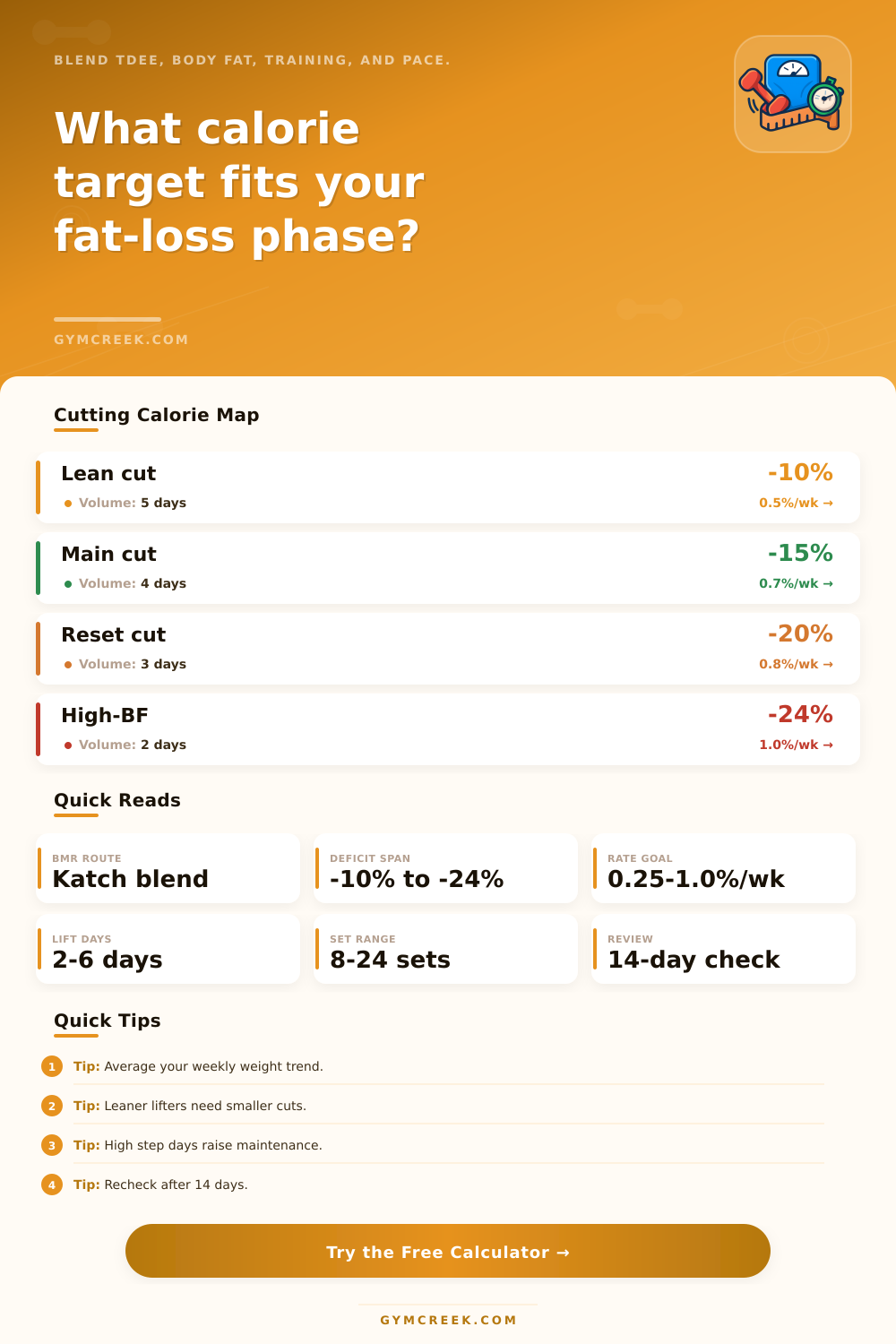
Each starter loads a body-fat level, activity base, lift volume, and weekly loss pace so you can compare an easy cut, a main cut, and a more aggressive reset without starting from blank fields.
⚙Calorie Target Inputs
Build your cut target
Enter your stats or load a preset to compare TDEE, deficit size, recovery floor, and expected weekly scale pace.
📊Cut Quality Metrics
📑Reference Library
| Deficit style | Shift | Best fit | Watch for |
|---|---|---|---|
| Recovery-first cut | -10% | Lean lifters or high-volume blocks | Slow scale drop can still work |
| Main cut | -15% | Most fat-loss phases | Daily hunger swings |
| Assertive cut | -20% | Moderate body fat with average volume | Performance drift |
| Reset cut | -24% | Higher body fat and lower gym stress | Recovery floor conflicts |
| Body-fat context | Typical range | Cut ceiling | Why it matters |
|---|---|---|---|
| Lean | Men under 12%, women under 20% | About 10% to 12% | Recovery and gym output drop faster here |
| Mid-range | Men 12% to 20%, women 20% to 30% | About 15% to 18% | Usually the easiest place to run a steady cut |
| Higher-BF | Men over 20%, women over 30% | About 20% to 24% | Larger deficits are often tolerated better |
| Unknown | No solid body-fat estimate | Stay conservative first | Use scale and waist trend to confirm |
| Weekly pace target | Daily deficit | Typical use | Read on adherence |
|---|---|---|---|
| 0.25% body weight | Small | Lean phases and longer dieting | Easy to recover from |
| 0.50% body weight | Moderate | Default for most cuts | Balanced pace and training quality |
| 0.75% body weight | Firm | Shorter, more urgent cuts | Requires tighter tracking |
| 1.00% body weight | Aggressive | Higher-BF resets | Often capped by recovery rules |
| Training volume | Lift days | Hard sets | Cutting note |
|---|---|---|---|
| Light | 0 to 2 | 0 to 10 | More room for a bigger calorie gap |
| Moderate | 3 to 4 | 11 to 17 | Works well with a main cut |
| High | 4 to 5 | 18 to 24 | Sharper deficits need caution |
| Very high | 5 to 6 | 25+ | Prefer recovery-first cuts and small pace targets |
| Formula route | Inputs | Output | Best use |
|---|---|---|---|
| Katch-McArdle | Lean mass from body fat | BMR | Best when body-fat data is credible |
| Mifflin-St Jeor | Age, sex, height, weight | BMR | Conservative fallback |
| Activity bridge | BMR and multiplier | TDEE | Base maintenance estimate |
| Rate target math | Body weight and weekly pace | Daily deficit | Turns scale pace into calories |
| Common scenario | Model | Preferred lane | Likely outcome |
|---|---|---|---|
| Lean athlete in season | Conservative baseline | Recovery-first cut | Smaller drop, better output |
| Office worker with restart goal | Cut-aware blend | Main or assertive cut | Clean fat-loss pace |
| Weekend-only lifter | Lean-mass first | Main cut | Steady deficit with enough fuel |
| Higher-BF low-volume phase | Cut-aware blend | Reset cut | Fastest pace the guardrails allow |
💡Coach Notes
If the scale is already falling faster than planned, keep calories steady before cutting further. A 14-day average is more useful than reacting to one light weigh-in or one salty day.
When body fat is low and gym volume is high, recovery limits the deficit before discipline does. A slower weekly rate often preserves strength, steps, and training quality better.
Fat loss occur when the calories a person consume are less than the calories a person burns daily. The difference between the calories consumed and burned is referred to as an calorie deficit. The total daily energy expenditure (TDEE) is the total number of calories that a person burn daily.
A persons TDEE isnt a fixed number. The TDEE can change as a result of a persons steps taken daily, their training volume, and their age and sex. Due to these factor affecting the TDEE, it is impossible for a person to use a standard calorie number to achieve fat loss.
How to Lose Fat with Calories, Protein and Exercise
The percentage of body fat that a person have can indicate to them the size of the calorie deficit that they should employ. If a man has a body fat percentage below 12%, or if a woman has a body fat percentage below 20%, then the man or woman is considered to be lean. Individuals who are lean should use smaller calorie deficit to avoid losing muscle and strength.
If a man’s body fat percentage is 20% or more, or if a womans body fat percentage is 30% or more, then the man or woman contains more body fat than others. Individuals who has more body fat can use larger calorie deficits because they have more fat reserves to utilize for energy. Additionally, if an individual performs more lifting set during their training period, they will require more calories to support their strength and training.
Therefore, they should use a smaller calorie deficit to achieve these goals. A person can perform a measurement of fat loss by measuring a persons weight per week. The goal for most individuals is to lose 0.5% of their total body weight per week.
Losing 0.5% of total body weight per week will allow individuals to lose fat at a steady rate without experiencing metabolic issues. For individuals who have a higher percentage of body fat and perform less training than others, the goal may be to lose 1% of their total body weight per week. For individuals who are lean and perform high levels of training, however, they should aim for a smaller percentage of total body weight to lose each week.
The number of steps that a person takes daily impact their TDEE. The more steps that a person takes, the more higher their TDEE will be. This allows for them to consume more calories daily while still maintaining a calorie deficit.
There are different method for calculating an individuals TDEE. One method is to calculate an individuals lean body mass. If an individual knows their body fat percentage, this will provide them with an accurate calculation of their TDEE.
The other method for calculating TDEE is to use their age, height, weight, and their sex. This provides a more conservative estimation of their TDEE. An individual can calculate their TDEE using these methods and then take the average of the two number.
Once an individual finds their TDEE, they can apply a deficit to that number. An individual who performs alot of lifting sets during their training may use a 10% calorie deficit. An individual who is restarting their diet at a lean body fat percentage may use a 24% calorie deficit for the same period of time.
The adherence to a calorie deficit is crucial in the fat loss process. Some may want to use the largest possible deficit in relation to their TDEE. However, this is not the best method for the majority of individuals.
If an individual takes a high number of steps daily, their TDEE will be higher. This allows them to consume more calories daily while maintaining a calorie deficit. An individual should track their weight for a 14-day average instead of their weight daily.
An individual’s weight daily will fluctuate due to water retention. The 14-day average will provide a more accurate reflection of an individuals fat loss. A critical factor during fat loss is the protein that a person consumes daily.
An individual should consume 1.8 grams of protein per kilogram of lean body mass. Consuming 1.8 grams of protein per kilogram of lean body mass will aid in the preservation of their muscle tissue during fat loss. Even if an individual is in a calorie deficit, they must ensure that they are getting enough protein in their diet.
Additionally, an individual must take into consideration their recovery. The calorie deficit that an individual uses should not be so great as to drop their total calorie intake to a minimum intake. An individual needs a minimum amount of calories to provide the energy necessary to perform their training.
The load that an individual applies to their training will also dictate the size of the calorie deficit that they use. If an individual is performing light training for the week, they can use a higher percentage of calorie deficit. If, however, an individual is performing high levels of training, they should use a lower percentage of calorie deficit to allow their body time to rest and recover.
In addition to weight, an individual should also track their waist measurement. This will be a better indication of the fat loss that they are experiencing. Finally, an individual should reevaluate their fat loss goals every two week.
If they are losing too much or too little fat, they should adjust the percentage of their calorie deficit. A person can lose fat if they incorporate these factor into their fat loss programs. As a result, they will be able to lose fat in an efficient, healthy manner that will not endanger there health.