Calorie Intake Calculator Body Fat Percentage
Turn body-fat percentage into lean-mass calories, compare Katch and Mifflin BMR paths, then set a cut, hold, or gain intake that fits your weekly output.
Each profile loads a realistic body-fat case and recalculates the intake target right away.
Calorie target snapshot
Enter your stats and calculate to compare the BMR routes.
| Target lane | Shift | Best fit | Scale cue |
|---|---|---|---|
| Fast cut | -18% | Higher body fat | Noticeable drop |
| Steady cut | -12% | Most fat-loss phases | Controlled decline |
| Recomp trim | -5% | Lift quality focus | Slow drift down |
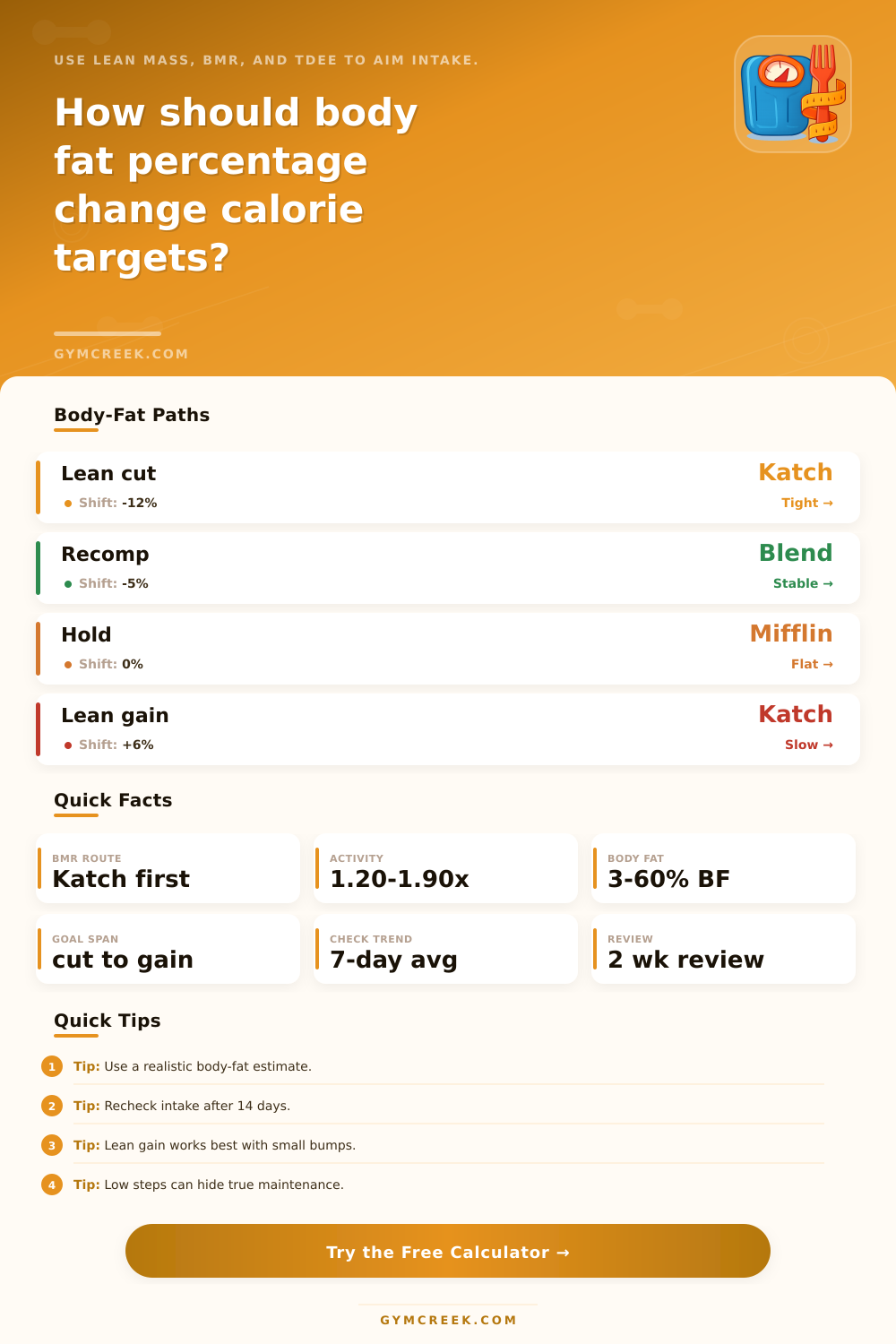
| Lean gain | +6% | Low to moderate body fat | Slow climb |
| Activity pattern | Factor | Step band | Starting note |
|---|---|---|---|
| Sedentary | 1.20 | Below 5k | Be conservative first |
| Lightly active | 1.35 | 5k to 8k | Common office baseline |
| Moderately active | 1.55 | 8k to 12k | Solid training week |
| Very active | 1.70 to 1.90 | 12k and up | Expect more intake |
| Body fat zone | Lean-mass note | Calorie bias | Watch for |
|---|---|---|---|
| 10-14% M / 18-22% F | Katch often reads higher | Tiny deficit or lean gain | Recovery dips |
| 15-19% M / 23-27% F | Prime recomp window | Small trim or hold | Daily hunger swings |
| 20-24% M / 28-32% F | Lean mass still matters | Steady cut | Overestimating movement |
| 25%+ M / 33%+ F | Higher cut tolerance | Fast or steady cut | Low protein intake |
| Formula route | Uses | Output | Best use |
|---|---|---|---|
| Katch-McArdle | Lean mass from body fat | BMR | Known body-fat estimate |
| Mifflin-St Jeor | Weight, height, age, sex | BMR | Baseline or fallback |
| Activity bridge | BMR x factor | TDEE | Daily output estimate |
| Goal shift | TDEE plus cut/gain lane | Intake target | Planning daily calories |
| Common scenario | Method | Goal lane | Likely result |
|---|---|---|---|
| Higher-BF desk worker | Body-fat first | Steady cut | Clean fat-loss start |
| Lean lifter in prep | Blended | Recomp trim | Smaller calorie drop |
| Weekend-only trainer | Mifflin baseline | Hold | Safer first estimate |
| Low-BF builder | Body-fat first | Lean gain | Slow scale increase |
Calories do not tell the whole story about energy needs due to body composition. Body composition include fat mass and lean mass, and lean mass burns more calories than fat mass do when at rest. If you ignore the difference in calorie burn between fat and lean mass and use total body weight as a starting point for determining calorie needs, you may end up with inaccurate figure.
Using body fat percentage will allow you to base your calorie intake on your metabolism. A 200-pound person with 25% body fat has more body fat than a 200-pound person with 15% body fat. The person with 15% body fat have more lean mass, meaning they burn more calories at rest than the other individual.
How body fat and muscle affect your calorie needs
The Katch-McArdle formula take lean mass into consideration when calculating basal metabolic rate. One benefit of using this formula is that it ignore body fat mass. Other formulas, like the Mifflin-St Jeor formula, do not consider lean mass separately since it assumes that all body weight burn the same amount of calories at rest.
The Mifflin-St Jeor formula may provide inaccurate results for individuals with a higher percentage of body fat. The basal metabolic rate is the basis for determining total daily energy expenditure. Total daily energy expenditure is the basal metabolic rate plus the calories burned through physical activity.
The level of physical activity an individual perform each day will alter the daily energy expenditure total. Activity level can be tracked in various ways. For instance, a person who weighs 170 lbs.
And has a resting metabolic rate of 1300 calories per day who has a sedentary job and walks 4,000 steps per day may use a factor of 1.2 to adjust their daily energy expenditure total. However, a person who weighs 170 lbs., has the same resting metabolic rate as the individual above, who also walks 10,000 steps per day and lift weights four sessions a week may use a factor of 1.55 or higher to calculate their total daily energy expenditure. Steps account for non-exercise activity.
Non-exercise activity is also accounted for in total daily energy expenditure. Training sessions that incorporate lifting weights will increase total daily energy expenditure. Your body fat estimate will impact how you calculate total daily energy expenditure.
If you use a body fat estimate, you will use lean mass in your calculation. Otherwise, energy expenditure will be calculated using height, age, weight, and sex. Your goals will determine how you adjust your total daily energy expenditure.
For instance, if you want to lose fat, you may calculate a calorie intake that is 12% lower than your total daily energy expenditure. If you want to undergo body recomposition, which is losing fat but maintaining or gaining muscle, you may calculate a 5% intake of your total daily energy expenditure. Individuals with a higher percentage of body fat can tolerate greater calorie deficits of up to 18% then those with a lower body fat percentage.
If you want to gain weight, you may adjust your calorie intake to 6% above your total daily energy expenditure. This will allow you to gain weight but not gain excessive body fat. Various real-life factors may complicate your calculations of your total daily energy expenditure.
For example, an individual with a 28% body fat percentage and a sedentary job may have a lower total daily energy expenditure if they use the body fat percentage in their calculations for total daily energy expenditure. Tracking their body fat over two weeks will show whether their weight is dropping steady. They should also pay attention to their hunger levels.
Low activity levels may make it difficult to determine their total daily energy expenditure. Checking their progress every 14 days may help them to better understand their body composition. Such checks will allow them to adjust their total daily energy expenditure accordingly.
Many individuals make mistakes when they calculate their energy needs. For example, a fitness watch that is used to track an individual’s steps may overestimate the number of steps they take. An individual who calculates their body fat without using calipers or a DEXA scan may also overestimate their body fat percentage.
Many individuals try to lose weight too quick, which will eventually stall their metabolism. To avoid such mistakes, you can blend the Katch-McArdle formula and the Mifflin-St Jeor formula to provide a more accurate calculation of total daily energy expenditure. Consistency in adhering to the calculated total daily energy expenditure is more important than perfect calculations.
Tracking your weight each week will give you a better view of your total daily energy expenditure than daily weigh-ins. Calculating the average of your weight each day for a week will smooth out the effect of eating meals with others or eating high-calorie meals when stressed. Consuming the proper amount of protein will help you maintain your lean muscle.
A recommended amount of 1.6 to 2.2 grams of protein per kilogram of lean mass per day will provide enough protein to aid in maintain muscle. Both sleep and the number of steps you take will impact your results. Getting poor sleep may reduce the effectiveness of your calorie target.
If you have an irregular sleeping schedule, your total daily energy expenditure may fluctuate. In such cases, using the Mifflin-St Jeor formula to calculate your total daily energy expenditure may provide you with a more consistent starting point. Projecting your total daily energy expenditure over a one-week period will allow you to see how many calories you want to consume to achieve your weight goals.
If after two weeks, your weight remains the same, you may need to adjust the number of calories you consume.